
Your site exists, but nobody can find it
You type your company name into Google and it appears on the first page. Perfect. Now type in what your customers are really looking for: "plumber [your city]", "Italian restaurant [your neighborhood]", "divorce lawyer [your region]".
Where is your site? Page 3, page 5, invisible.
The problem isn't the competition. It's your SEO. Four technical errors explain why Google is ignoring you.
Google doesn't know where you work
A plumber in Lyon doesn't want customers in Marseille. However, the majority of small business sites never specify their area of operation in a way that can be used by Google.
You've put your address at the bottom of the page, in an image or a PDF. Google doesn't read images. It looks for structured text. If your city doesn't appear in your titles, descriptions and content, Google considers that you work everywhere, and therefore nowhere.
What works
- Mention your city in your service titles
- Create a page dedicated to your area of operation
"Fast response plumber Lyon 3rd" > "Professional plumber for 15 years". The first tells Google who you are and where you are. The second says nothing.
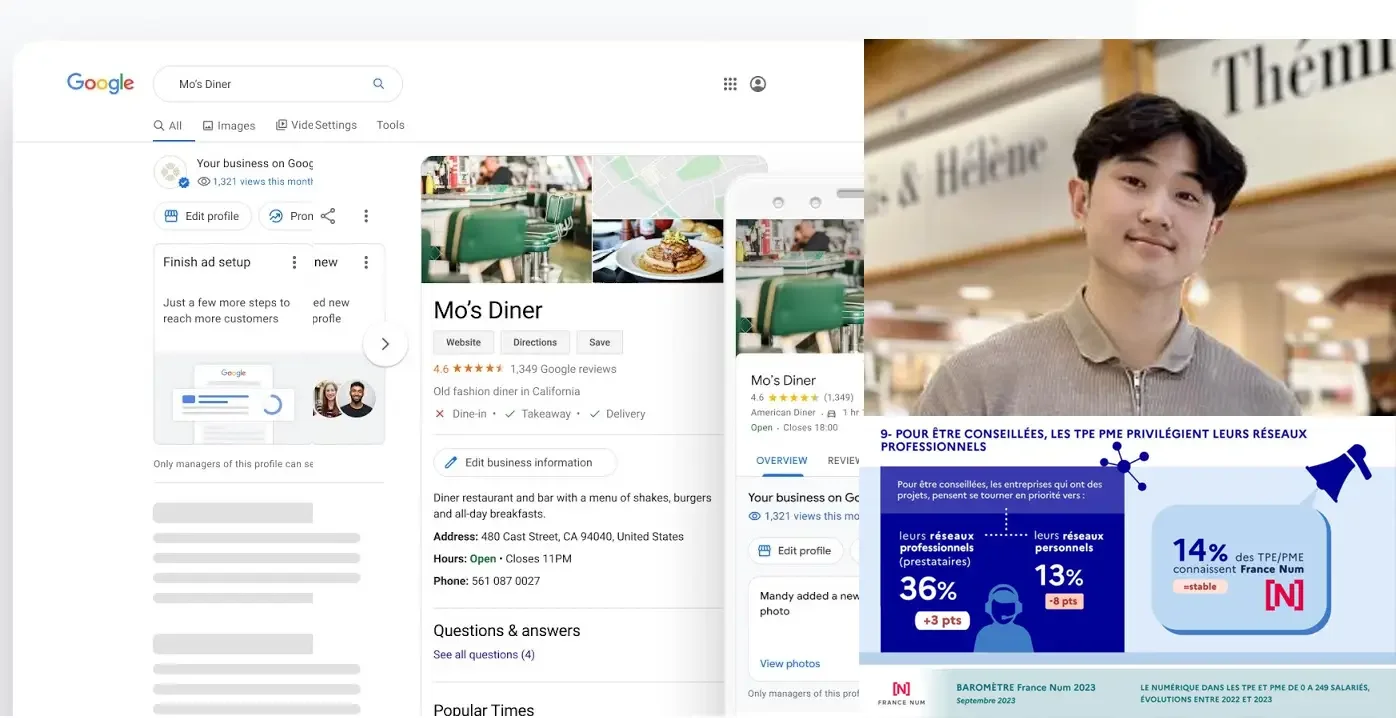
Create your Google Business Profile. Free, 20 minutes to set up. Without it, you don't exist for local searches. It's what makes your business appear in the right-hand block with map, reviews and opening hours.
Your pages don't answer any specific questions
You have a "Our services" page that lists everything in three lines per service. Google hates this. So do your customers.
Someone looking for "water leak repair under sink" wants to know if you respond quickly, how much it costs, and how to contact you. Not read a generic list.
Each service deserves its own page
Not a paragraph, a real page of 300-500 words that explains:
- The problem you solve
- How you work
- Concrete examples
- Your rates or a price range
- A clear call-to-action button
Many small businesses think that a 5-page site is enough: home, services, about, contact, legal notices. Result: Google doesn't know how to rank you. Meanwhile, your competitor has created 15 detailed pages on each service and is capturing all the traffic.
Simple method
Write down your customers' recurring questions. Each question = one page.
- "How much does an electrical repair cost?"
- "Can you renovate a bathroom while keeping the plumbing?"
- "What documents are needed for an amicable divorce?"
Google considers you a relevant source when you clearly answer these questions.
Your site is unreadable on smartphone
75% of Google searches are done from a mobile phone.
If your site loads in 10 seconds, if the text is microscopic, if the buttons are impossible to click, you lose three out of four visitors.
You probably check your site on a computer. Everything works. But your customers search while leaving the subway, at checkout, during their break. They land on your site, struggle, and move on to the next one.
Google measures loading time, bounce rate, ease of navigation. Slow or poorly adapted site = penalty in results, even with good content.
Immediate test
Open your site on your phone now. Not a simulator, your real phone with your 4G connection.
- Time the loading
- Find your phone number in less than 10 seconds
- Fill in the contact form
One frustrating action = problem identified.
The good news: most mobile problems can be fixed in a few hours. Images to compress, layout to adapt, buttons to enlarge. No complete overhaul, just technical adjustments that change everything.
You haven't published anything since the site was created
Google favors active sites. A site frozen for two years sends a negative signal: is this company still in business? Is the information up to date?
You don't need to publish daily. One article per month is enough. A plumber can write:
- "How to avoid frozen pipes in winter"
- "Our three most complex jobs this month"
- "New 2025 rates and why prices have changed"
Three advantages
- Additional content for SEO
- Answers to your potential customers' questions
- Positioning as an expert
A customer hesitates between two craftsmen? The one who publishes regularly inspires more trust than the one whose site has been frozen since 2022.
Solution for lack of time
Dictate your ideas on your phone during a commute. Send the audio file to your provider or use an automatic transcription tool. 15 minutes of dictation = a 500-word article. Once a month.
What your competitors are doing while you wait
They're fixing these errors methodically. Page per service, mobile optimization, geographic area everywhere, regular content. Nothing complicated, nothing magical. Consistent, intelligent work.
Visibility on Google isn't about budget or ultra-sophisticated sites. It's about relevance. Google wants to offer the best answer. If your site clearly answers questions, works well on all devices, and is regularly updated, Google trusts you.
Where to start
- Priority 1: Mobile - Test your site on smartphone. If loading is slow or navigation painful, contact your provider for optimization. This is the problem that costs the most customers.
- Priority 2: Geolocation - Check if your city appears in your titles and descriptions. Add it naturally. "Plumber in Lyon" > "Plumber". "Divorce lawyer Marseille" > "Family law attorney".
- Priority 3: A real service page - Create a complete page (300-500 words) for your main service. Explain concretely what you do, for whom, how, approximate price. This page alone can generate 10-20 contacts per month.
- Priority 4: One article per month - Note your customers' recurring questions and turn each answer into content. In six months: six new articles, six new entry points for Google.
Visibility is built
Your site will never be visible by magic. Google analyzes your content, your technical structure, your activity. If these elements are neglected, you remain invisible even with the best design.
These four errors explain 90% of visibility problems for small businesses. You don't need a 2,000 euros/month SEO agency to fix them. You need to understand how Google works and do the work, step by step.
Your competitors on the first page are no better than you. They've stopped making these mistakes. It's up to you to decide whether to continue being invisible or to build a real online presence.