
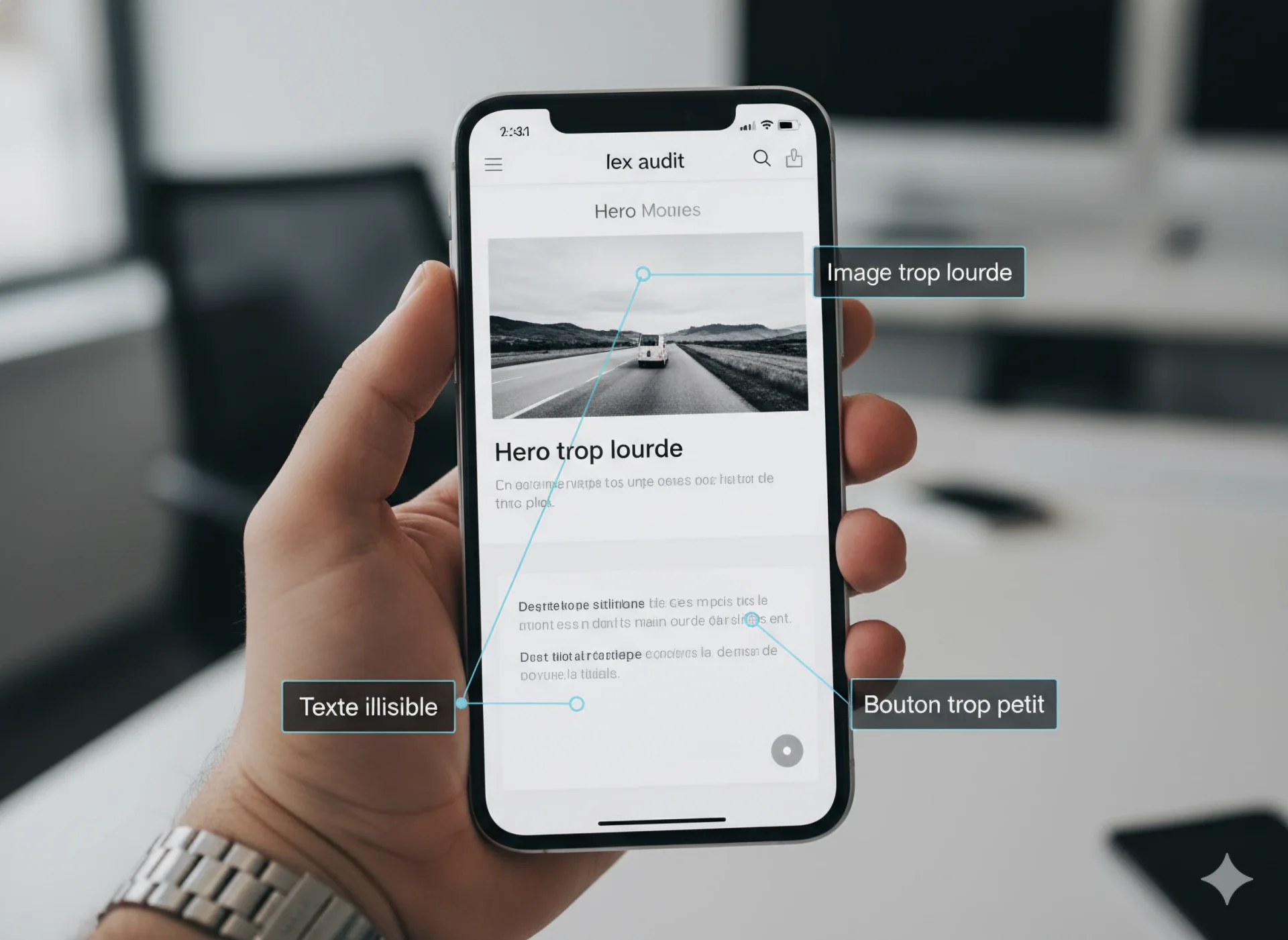
In a previous article, we looked at why AIs ignore certain sites: unclear content, confusing structure, lack of perceptible reliability. But understanding what you're doing isn't enough. AIs also value the technical quality of your site. And on this point, they are ruthless.
Why technology matters as much as content
Imagine an AI that has to answer the question "Which photographer for a wedding in Lyon?"
It crawls your site. Your content is clear. Your portfolio is convincing. But your site takes 5 seconds to load on mobile. Or the photo gallery "skips" during display. Or the contact button is unreadable on a smartphone.
The AI won't risk recommending you
Why? Because it doesn't offer 100,000 results like Google. It offers one answer. Just one. Sometimes two. It can't afford to send a user to a slow, unstable or poorly designed site. For the AI, a technically flawed site = a risk to the quality of its response.
AIs want to protect the user. That's their logic.
Examples that speak for themselves
- An independent graphic designer with a magnificent portfolio... but 5 MB images that take 8 seconds to load. The AI will skip them in no time.
- A home care nurse with all the necessary information... but an unreadable phone number on mobile. AI considers this a risky experience.
- An artisan carpenter with 20 WordPress plugins that slow down every page. AI moves on.
- A consultant with solid expertise... but messy titles and chaotic HTML structure. The AI doesn't understand the organization of the content and doesn't quote it.
These are not extreme cases. They are common situations. And in each case, the problem is not the content, nor the quality of the work. It's the technical execution.
So, what exactly do AIs look for?
AIs screen your site technically before deciding whether or not to recommend it. They don't do this out of malice, but because they need guarantees. Six criteria dominate their evaluation:
1. Mobile speed is the most decisive criterion
70-80% of visits are made on smartphones. AIs know this. So they prefer sites that open in less than 2 seconds on mobile. If your site takes 4 seconds to display, it's very unlikely that an AI will cite it.
AIs analyze image weight, JavaScript size, speed of first display, post-click activity and overall fluidity. They don't tolerate compromise on this point. A slow site = a site they systematically downgrade.
2. HTML structure must be logical
To understand your site, AIs need a clear structure: a single main heading, consistent subheadings, paragraphs that follow one another, lists when necessary, clearly identified sections.
AIs penalize sites built in a "patchwork" fashion, where buttons are placed anywhere, blocks appear out of order, and elements lack hierarchy. A poorly structured site is less understandable, and therefore less recommendable.
3. Mobile-first should be real, not cosmetic
It's no longer enough to say "my site is responsive". AIs test the size of buttons, ease of calling, legibility of text, distracting elements, menus that are too small, poorly adapted popups. A site that works only on a computer is considered unusable.
4. Visual stability is unforgiving
Many sites look fine on the PC, but "shift" on mobile: the image loads and pushes the text, the button suddenly drops, the page shakes for 2 seconds. AIs spot these faults instantly. For them, unstable means poor experience, and therefore unreliable.
5. Technical errors are visible to AIs
AIs see everything a human doesn't: broken images, inconsistent redirects, scripts that crash, excessive weight, bad tags, missing attributes. A simple but clean site is considered more credible than a technically broken design site.
6. Structured data make it easier to understand
AIs particularly appreciate information encoded in schema.org format: address, opening hours, reviews, activity description, listed services. This data helps them understand your business. Without it, they guess, and rarely guess right.
What makes a real difference for your business
These technical criteria may seem abstract. But they have a direct impact on your visibility.
A technically clean site will be cited by AIs even if it's simple. A slow or unstable site will be ignored, even if the content is excellent. AIs prefer structure and coherence to aesthetics and marketing.
It's a paradigm shift: for years, we optimized for Google. Now you also have to think about the AIs that analyze your site differently. They don't count keywords. They evaluate the full experience.
Simple actions to implement
Good news: you don't need an expert developer or an expensive consultant. The actions are simple and common sense.
- Start by compressing your images and using WebP format
- View your site on smartphones, page by page
- Simplify your home page by removing superfluous elements
- Reduce the number of plugins if you're on WordPress
- Watch out for pages that take more than 3 seconds to load
- Correct visible errors such as broken images or dead links
- Structure your titles logically with a single main title per page
These are not technical optimizations for experts. These are common sense rules that improve the experience for everyone: human visitors, Google, and now AIs.
In summary
AIs don't ignore you for lack of interest in your business. They often ignore you for lack of technical clarity. It's not a question of being "interesting", but of being readable, fast and stable.
A technically simple but clean site will always be treated better than a complex and fragile one. AIs are looking for reliability above all else. And reliability starts with technology.
Webful analyzes your site as an AI would: mobile speed, stability, readability, structure, page weight, errors.
And turns this into simple actions at webful.fr